CenWan on Glue Application Methods and Control
Posted by cenwan cenwan
Filed in Other 1 view
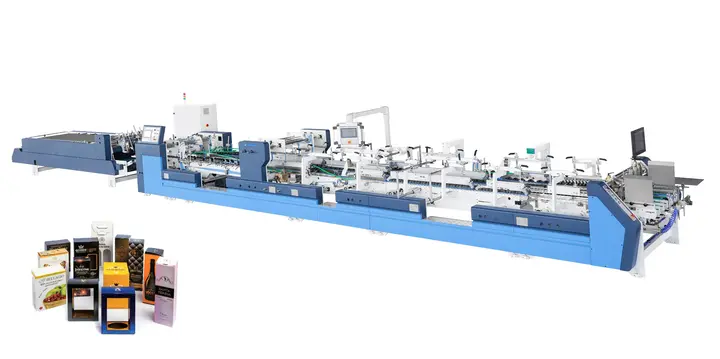
Stand beside a running line for ten minutes and you will hear a steady rhythm of belts hissing, glue guns clicking and flat blanks turning into boxes faster than the eye can follow, which makes plenty of newcomers ask how a Folder Gluer Machine keeps every carton so square and so consistent?
Everything begins at the feeder. Flat blanks sit in a stacked hopper, and a set of bottom belts or vacuum wheels pulls the lowest sheet forward in a steady stream, one at a time, with a small gap between each. If that gap drifts, every later stage drifts with it, so a lot of operators spend more time fine tuning the feeder than any other section.
Next comes the side registration, a quiet but important part. A guide or a set of angled belts nudges each blank sideways until its edge sits against a fixed reference line, and the machine treats that line as the truth for everything that follows. I have watched a line produce wavy, skewed boxes for an entire shift simply because this reference had been bumped out of place by a few millimeters.
The blanks then reach the pre-fold unit, where small hooked tools or fixed rails begin to bend the crease lines slightly before the main fold happens. This sounds minor, yet it makes a large difference with stiff board or heavy coatings, because a crease that has been coaxed open ahead of time folds cleanly instead of fighting back. Boxes that spring open again after folding are often a pre-fold problem rather than a glue problem.
Glue application is where the sound changes, a faint tick and hiss as nozzles fire onto the flap. Cold glue systems use wheels or guns that deposit a thin, controlled line, while hot melt systems heat the adhesive so it grips almost instantly. Sensors watch the passing blank and trigger the nozzle at exactly the right moment, and a good setup lays down a bead that is even from one end of the flap to the other.
After the glue lands, the folding section takes over. Upper and lower belts grip the blank gently on both sides, carrying it forward while curved rails or hooks swing the side panels over and press them onto the glued flap. For crash lock or four corner bottoms, extra hooks and a small twisting motion lay the bottom panels into place before they close, and the whole movement happens so smoothly that it looks almost effortless.
The belts themselves deserve a mention. They are driven in pairs, and their speed must match so closely that the carton does not twist as it travels. When one belt runs even slightly faster, the box leaves the folding section with one corner ahead of the other, and you can see the damage in a row of finished cartons as a faint diagonal lean.
Then the cartons enter the compression section, a long stretch where the glued joint is held under steady pressure while the adhesive sets. Pressure that is too light leaves weak seams that peel later, while pressure that is too heavy squeezes glue out and crushes the board along the crease. Many plants run a short test stack, press on the glue line by hand and look for the tiny tear of fibers that signals a proper bond.
Control technology ties all of this together. Servo motors drive key sections with precise speed and position, and a touch screen stores the settings for each job so an operator can recall them rather than start from scratch. Cameras or sensors inspect for missing glue, skewed boxes and double feeds, then trigger an ejector that kicks out a faulty carton without stopping the line.
Finally the finished boxes reach the delivery section, where a counter and kicker divide them into neat batches, often with a small gap or a tilt so a worker can strap or pack each stack quickly. If you want to compare how different configurations arrange these functions, the listings at https://www.cenwanmachine.com/product show a wide range of layouts and options, and understanding each stage makes it far easier to judge what a Folder Gluer Machine can realistically deliver on your own production floor.