Why Does Befair Colander Pasta Strainer Hole Design Affect Drainage
Posted by Befair Befair
Filed in Technology 1 view
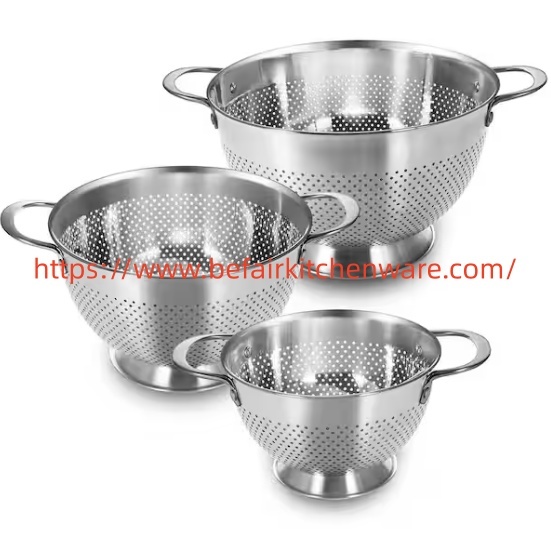
Colander Pasta Strainer performance is closely connected to the size, shape, spacing, and placement of its openings. When buyers compare kitchenware, drainage speed is only part of the decision. The openings also need to retain food properly, remain easy to clean, and work with the ingredients commonly prepared in the kitchen. For manufacturers, finding the right balance between these factors is an important part of product development.
The diameter of each opening directly affects how quickly liquid can pass through. Larger openings generally provide a wider path for water, while smaller openings restrict the flow to some degree. However, choosing a larger opening simply for faster drainage may not suit every food.
Pasta comes in many shapes and sizes. Long strands, small pieces, and compact shapes behave differently during draining. Smaller ingredients may pass through larger openings, while very fine openings can retain food but may become blocked by starch or small particles. For this reason, manufacturers need to consider the intended application before deciding on a perforation diameter. A design intended mainly for long pasta may have different requirements from one intended for small pasta shapes or mixed kitchen tasks.
Opening size is not the only factor affecting drainage. The distance between openings and their overall distribution also influence how water moves through the basket. If openings are concentrated in one area, water may take longer to leave when food covers that section. A more evenly distributed pattern can provide multiple drainage paths. Side openings can also help liquid escape when ingredients are piled toward the center or when the container is held at an angle.
For manufacturers, perforation patterns should be considered together with the shape and depth of the container rather than designed separately. A deeper basket can hold more ingredients, but food may collect toward the center during use. A suitable base structure can help guide water toward available openings.
Fast drainage has little practical value if food escapes through the openings. This is especially relevant for smaller pasta varieties, grains, chopped vegetables, and other ingredients with dimensions close to the opening size. A balanced design keeps the contents inside while allowing excess water to leave without unnecessary delay.
Different markets can also require different configurations. A household product may focus on common pasta and vegetable preparation, while commercial kitchens may require larger capacities or several configurations for different preparation tasks. Buyers should therefore consider the ingredients and quantities their customers are likely to handle before selecting specifications.
The overall form also influences drainage. The position of openings should follow the movement of both food and liquid. Openings along the side walls can provide additional escape routes, while a carefully arranged base pattern can reduce areas where water remains trapped.
Surface finish deserves attention as well. Opening edges should be properly formed and smooth enough to support convenient cleaning. Rough areas may collect food particles and make maintenance more difficult. Consistent finishing around each opening can contribute to a more comfortable user experience.
Cleaning requirements should be considered alongside drainage. Very fine openings may need additional attention when starchy foods leave residue behind. Buyers should therefore evaluate not only how liquid leaves the container during use, but also how easily the product can be cleaned afterward.
Manufacturing consistency becomes important when purchasing in quantity. Buyers can review dimensional tolerances, opening size, spacing, surface quality, structural strength, inspection procedures, packaging, and customization options. Consistent production helps manufacturers maintain the intended specifications across different batches.
Befair focuses on practical kitchenware development with attention to product structure and everyday use. Buyers can discuss opening dimensions, arrangement, material selection, capacity, handles, base structure, packaging, and other specifications according to their intended market. This can be useful when a standard configuration does not fully match a particular application.
Before placing an order, buyers should identify the ingredients the product will commonly handle. They can then compare opening diameter, spacing, distribution, basket depth, capacity, surface finish, and base structure. Requesting samples can also help purchasers evaluate actual drainage and food retention before larger production runs.
The goal is not simply to create more openings or make them larger. Practical design comes from balancing liquid movement, food retention, cleaning, handling, and manufacturing requirements. Buyers who assess these details together can make a more informed purchasing decision and communicate their expectations clearly to a supplier.
For buyers comparing different kitchenware configurations, Befair provides product options and manufacturing information through its product range at https://www.befairkitchenware.com/product/ Reviewing available designs and discussing specific requirements can provide a practical starting point for selecting a configuration suited to different kitchen applications.