How To Use Model Papers To Improve Your Own Academic Writing
Posted by Najwa Yaminah
Filed in Card Games 71 views
Most of us have been there when we are staring at a blank page, the deadline is creeping closer, and we have no idea how to begin our assignment. Being in that position, I mostly know what I want to say. But the gap between thoughts and producing structured assignments feels impossible to cross.
Do you know how to close that gap? You thought of a YouTube tutorial? Or a grammar guide? Well, that won’t work.
It actually fills the gap by studying what strong academic writing skills look like. Looking close to real papers by those people who have figured it out. That is exactly what model papers are for. Not to paraphrase with a thesaurus. But to study and understand a real assignment and get guidance from it.
What is a Model Paper?
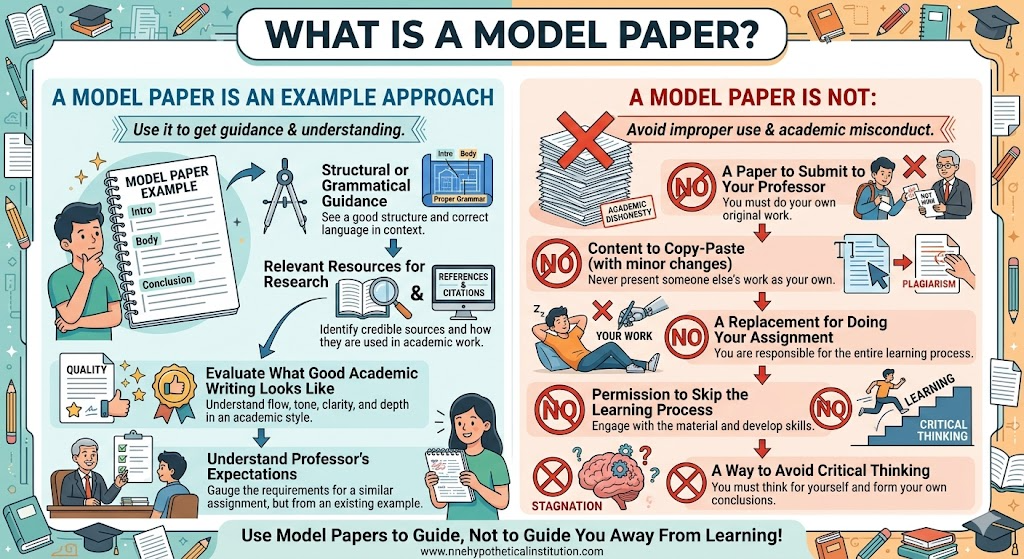
A model paper is an example approach to a specific assignment. It can be used:
-
To get structural or grammatical guidance.
-
To get relevant resources for research.
-
To evaluate what good academic writing looks like.
-
To understand the professor's expectations for a similar kind of assignment, you are working on.
A Model Paper is NOT:
-
A paper that you can submit to your professor
-
Content that you can copy-paste with a few changes and submit
-
A replacement for not doing your assignment
-
Permission to skip the learning process
-
A way to avoid critical thinking
There is a fundamental misconception about model papers among students. Many students look at one the way they look at a finished meal. They just want to consume it. Well, the smarter way is to treat it like a recipe. You are there to understand the method, not to steal the dish.
What to Look For In a Model Paper?
If you have a model paper relevant to your assignment. Then, before you sit with it, here is what you must know:
-
The thesis as a thinking framework. The first thing I do with any model paper is locate the thesis and reverse-engineer it. What claim is being made, how specific is it, and how does it set up what follows? A strong thesis acts like a promise to readers.
-
Paragraph architecture over paragraph content. Each body paragraph in a well-written academic paper follows a logic: it opens with a claim, supported with evidence, explains why that evidence matters, and connects back to the broader argument. The National Council of Teachers of English identifies this structure as the most common failure point for undergraduate writers.
-
Hedging language and academic register. This is what students do not look for, yet it is one of the clearest markers of academic maturity. Skilled writers use phrases like “the evidence suggests…” This is something professors immediately notice.
The Discipline-Specific Angle Nobody Talks About
Model papers do not work in the same manner across all disciplines. A humanities paper prioritises close reading and interpretive argument. A social sciences paper foregrounds methodology and hedged conclusions. A STEM paper follows an entirely different logic. If you are a business student studying a literature essay as a model, you are learning conventions that will actively work against you.
This matters specifically for those who use essay writing services for reference and learning support. The best providers offer field-specific model papers.
Using Model Thesis Chapters to Sharpen Long-Form Writing
This becomes even more critical for postgraduate students. Dissertations require steady arguments across tens of thousands of words and demonstrate original contributions. None of which a standard model paper prepares you for.
Students working on long-form academic papers, including those who access thesis help dubai universities, often report that studying the shift of a well-structured thesis chapter to literature review and methodology is more instructive than any writing workshop. The model does not tell you what to argue. It actually shows you the rhythm of scholarly reasoning. This can take years to develop without strong examples in front of you.
The Active Annotation Model
Reading a model paper passively and reading it analytically are two different activities. As you read, mark the following: the thesis and any restatements, each paragraph’s topic sentence, every piece of evidence and how it is introduced, counterarguments, and transitional phrases linking ideas across sections. After annotating, you will have a structural map to reference when planning your own draft.
This technique also trains you to notice the weaknesses in model papers. And it is equally valuable. Spotting where an argument is fading makes you a stronger self-editor over time.
Three Questions That Separate Good Writers From Average Ones
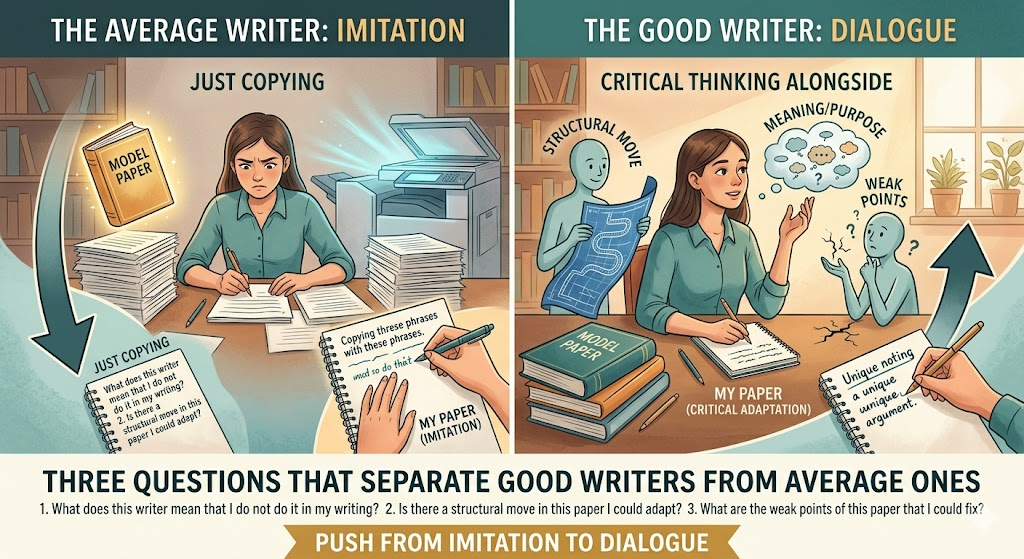
Have you studied the model paper? If so, now ask yourself these questions:
-
What does this writer mean by what I do not do in my writing?
-
Is there a structural move in this paper I could adapt (not copy) to serve my own argument?
-
What are the weak points of this paper that I could fix in my writing?
These questions push you from imitation to dialogue. You are no longer looking at a model paper. You are thinking critically. This is what academic writing ultimately demands.
Final Words
Students, keep in mind that model papers are not shortcuts. They are one of the most honest and effective tools available for academic writers at all levels.
The key to using it is intentionality. You must know what you are looking for, annotate actively, and then step away from the model paper completely, so that you sit and write your own assignment. Your paper must come from your thinking, be shaped by research, and be expressed in your voice.