Computer Vision Developers Building Intelligent Automation Systems
Posted by Techno yuga
Filed in Technology 81 views
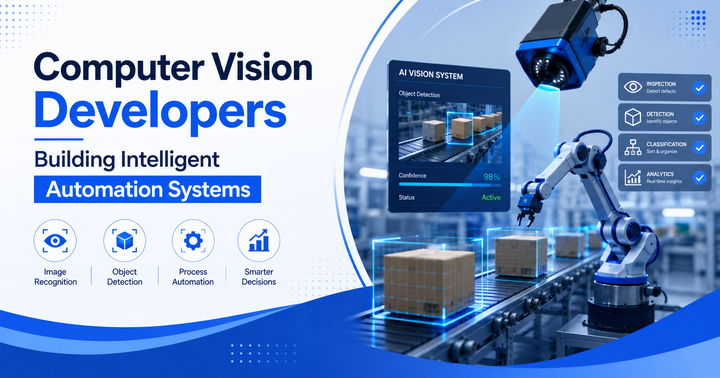
Walk into any modern warehouse, hospital, or manufacturing floor and you'll notice something that wasn't there a few years ago — cameras that don't just record, they think. A camera watching a conveyor belt flags a defective product before it reaches packaging. A sensor at a retail checkout counts inventory without anyone lifting a scanner. None of this happens by accident. Behind every one of these quiet, camera-driven decisions sits a team of engineers who've spent years teaching machines to interpret pixels the way humans interpret meaning. This is the world of computer vision, and for business owners trying to cut costs, reduce errors, and free up human hours, understanding who builds these systems — and how — has become less of a technical curiosity and more of a competitive necessity.
Why Vision-Based Automation Is No Longer Optional
Automation used to mean robots on an assembly line following fixed, repetitive instructions. Today's automation is different — it senses, evaluates, and reacts to a changing environment in real time, and that shift is entirely thanks to vision technology. A machine that can "see" a scratched surface, an unlabeled box, or a person standing too close to hazardous equipment doesn't just save labor costs; it prevents losses that would otherwise go unnoticed until it's too late. Business owners across manufacturing, logistics, retail, healthcare, and agriculture are discovering that the gap between companies using visual intelligence and those still relying on manual inspection is widening fast, and it's widening in favor of the former.
- Reduces dependency on manual, repetitive human inspection tasks
- Cuts down error rates in quality control and compliance checks
- Enables real-time decision-making instead of after-the-fact reporting
- Scales easily across multiple sites without proportional headcount increases
- Creates a data trail that improves operations over time
What Computer Vision Development Services Actually Involve
There's a common misconception that computer vision is just "installing a smart camera." In reality, computer vision development services cover a much broader pipeline — from collecting and labeling training data, to building and testing neural network models, to integrating that intelligence into existing business software and hardware. It's part data science, part software engineering, and part systems integration, which is exactly why so many businesses choose to bring in specialists rather than attempt it with an in-house generalist team. A good service provider doesn't just hand over a model; they build the entire pipeline that keeps the model accurate as your environment, lighting conditions, and products change over time.
- Data collection, annotation, and preprocessing tailored to your use case
- Model selection, training, and fine-tuning for specific detection or classification tasks
- Edge and cloud deployment strategies depending on latency and bandwidth needs
- Ongoing model retraining as new data patterns emerge
- Integration with ERPs, IoT devices, and existing business dashboards
Choosing a Computer Vision Development Company That Understands Your Industry
Not every technology partner is built the same, and this matters more in computer vision than in most other software domains because the problems are so visually and contextually specific. A computer vision development company that has spent years working with retail shelf-monitoring systems may not automatically understand the nuances of detecting micro-fractures in industrial pipelines. Business owners often make the mistake of judging a vendor purely on their technical stack, when the real differentiator is domain familiarity — how well the team understands your specific visual environment, your data limitations, and your operational constraints. The right company will ask more questions about your business before writing a single line of code than about the algorithms they plan to use.
- Look for proven case studies within your specific industry vertical
- Ask how they handle edge cases like poor lighting, occlusion, or camera drift
- Evaluate their approach to data privacy and on-device versus cloud processing
- Check whether they offer post-deployment support and model maintenance
- Assess their ability to explain technical decisions in plain business terms
The Engineering Backbone: Computer Vision Software Development
Underneath every polished vision-based product is a layer of software architecture most business owners never see, and that's exactly the point — it should work invisibly. Computer vision software development is where raw algorithms turn into production-grade applications that can run reliably twenty-four hours a day without crashing, lagging, or misreading data during a busy shift. This stage involves far more than training a model in a lab; it requires building robust APIs, handling real-time video streams, optimizing for hardware constraints, and ensuring the system degrades gracefully rather than failing outright when conditions aren't ideal. It's the difference between a flashy demo and a system your operations team can actually depend on every single day.
- Building scalable APIs to connect vision models with business applications
- Optimizing inference speed for real-time or near-real-time processing
- Designing fail-safes so the system alerts humans when confidence is low
- Ensuring compatibility across different camera hardware and resolutions
- Maintaining version control and rollback capability for deployed models
Partnering With a Computer Vision Software Development Company for the Long Haul
Building a working prototype is one milestone; keeping a system accurate and relevant six months or two years later is an entirely different challenge, and this is where long-term partnerships matter more than one-off projects. A capable computer vision software development company treats deployment as the beginning of the relationship, not the end of it. Products change, lighting setups shift, new SKUs get introduced, and cameras get replaced — all of which can silently degrade model accuracy if nobody is watching. Business owners who treat computer vision as a "build once, forget it" investment often find themselves back at square one within a year, while those who partner with teams offering continuous monitoring and updates see compounding returns instead of diminishing ones.
- Continuous performance monitoring to catch model drift early
- Scheduled retraining cycles as new data becomes available
- Clear service-level agreements for uptime and response time
- Transparent reporting on model accuracy and system health
- Flexibility to expand the system to new locations or use cases
What Sets Skilled Computer Vision Developers Apart
At the ground level, none of this works without the people actually writing the code, debugging the models, and stress-testing systems against real-world chaos. Computer vision developers are a distinct breed within the broader software engineering world — they need a working knowledge of mathematics, image processing, and machine learning frameworks, combined with the patience to deal with messy, unpredictable real-world visual data that never looks quite like the clean datasets used in academic papers. The best ones don't just chase model accuracy on paper; they think about how a system will behave when a camera lens gets dusty, when lighting changes at 4 PM versus 9 AM, or when a product's packaging design is updated without warning.
- Strong grasp of deep learning frameworks like TensorFlow, PyTorch, and OpenCV
- Experience handling real-world data variability, not just clean benchmark datasets
- Ability to balance model accuracy against processing speed and hardware cost
- Familiarity with deploying models on edge devices, not just cloud servers
- Communication skills to translate technical trade-offs for non-technical stakeholders
When and Why to Hire Computer Vision Developers
Deciding to hire computer vision developers usually isn't a decision made on a whim — it typically follows a period of recognizing that manual processes are costing more in errors, delays, or missed opportunities than an automated system would cost to build and maintain. The timing matters as much as the decision itself. Businesses that wait too long often end up rushing the process, cutting corners on data collection or testing, which leads to systems that underperform and erode internal trust in automation altogether. On the other hand, businesses that plan ahead — mapping out their use case, data availability, and success metrics before reaching out to developers — tend to see faster deployment and better long-term outcomes.
- You're facing rising costs from manual quality control or inspection processes
- Your business handles high volumes of visual data that humans can't process fast enough
- You need consistent accuracy that isn't affected by fatigue or human error
- You're expanding operations and need automation that scales without added headcount
- You want a competitive edge through faster, data-driven decision-making
Whether you decide to build an in-house team or work with an external computer vision development company, the underlying goal stays the same: turning raw visual data into decisions your business can act on instantly. The technology has matured to the point where it's no longer reserved for tech giants with unlimited R&D budgets — mid-sized manufacturers, regional retailers, and specialized healthcare providers are all finding practical, cost-effective ways to put vision-based automation to work. What separates the businesses seeing real returns from those still stuck in pilot-project purgatory usually comes down to one thing: choosing the right partner, and choosing them at the right time. Start by clearly defining what you want the system to see and decide, and the rest of the technical journey becomes far easier to navigate with the right computer vision developers by your side.